Wednesday, September 12, 2012

Motorsport Community Mourns Passing of Professor Sid Watkins


Notable figures in Motorsport took to social media today to share their thoughts and express their condolences on the passing of Professor Sid Watkins, Formula One’s long time racing doctor and medical principal.

Professor Watkins was one of the most influential and well respected figures in Formula One and motor racing at large. Driven by a singular pursuit in elevating racing safety, Watkins was largely credited as the architect of modernizing incongruous safety protocols to the stringent, streamlined standards that they are today. He was also a fervent advocate for driver safety, having served on the FIA’s Safety and Medical Delegate for 26 years. He realized a longtime dream in 2004 when he founded the FIA Institute of Motorsports Safety, a proving ground with the sole purpose of revolutionizing driver safety in racing.

Sid Watkins and Ayrton Senna

“What Sid Watkins did in the way of safety in Formula One was incredible," said F1 Supremo Bernie Ecclestone in a statement from the Formula One Website. "He gave his whole life to that cause, to make sure that it could be as safe as it possibly could be. We all owe him a debt of gratitude for his caring and commitment."

“When I invited him to join Formula One as its official doctor partway through the 1978 season, we discussed many aspects of safety and medical issues. We agreed that we needed a proper hospital at the track in the form of a fully equipped medical centre to stabilise injured drivers with immediate treatment, and a helicopter to transport them subsequently to specialist facilities, and that the helicopter pad had to be as close to that trackside hospital as possible.

“Sid carried all of those things through, and many more. After the accidents to Jochen Rindt and then Ronnie Peterson, I suggested that he should have a medical intervention car and that he should take responsibility for taking drivers into medical care.

“We always talked things through and worked together, and he then took care of all the medical things which I knew nothing about.

“I am pretty sure that he is irreplaceable. You only meet somebody of his calibre once in your lifetime.”

In the paddock Watkins was known for his unwavering sense of humour. As part of the first responders in the FIA medical team, Watkins’s presence was one of comfort for many drivers.

“It was Sid Watkins that saved my life in Imola 94,” Tweeted F1 Driver Rubens Barrichello. “Great guy to be with, always happy... [Thanks] for everything you have done for us drivers.”

Dario Franchitti shared a similar sentiment. “Rest in peace prof Sid Watkins. Every driver in every type of racing round the world owes you a huge debt of gratitude.”

Racer Alex Brundle, son of former F1 Driver Martin Brundle, expressed his gratitude and regret at not having the chance to thank Watkins in person.

“I've played a lot of football with my Dad,” Tweeted Brundle. “I wouldn't have if it wasn't for a bloke I never met called Sid Watkins. Never got to thank him.”

Professor Sid Watkins shares a laugh with McLaren team principal Martin Whitmarsh
Doctor Gary Hartstein, Watkins’s long time protégé and current medical chief on the F1 safety team, remarked on Watkins’s penchant for humour.

“It took me a few years before I actually called him Sid,” said Hartstein. “It was at Spa, maybe 1993, and I asked him if I could.

“And he said, ‘The bums sleeping on the stairs of my hospital call me Sid, I don't see why you shouldn’t.’”

Doctor Hartstein also reflected on the instrumental role Watkins played in shaping his own decision-making in the field.

“For a long time I wanted to call him every time I had to make a decision. Then I just started thinking ‘what would he do in this situation?’ And finally, for better or for worse, I realized I was doing just what he'd do, but probably not as well!

“When I told him this a few years ago, he smiled and said ‘Of course old boy! You’ve had a bloody great teacher!”

Bruno Senna conveyed his sympathy with a short but succinct message. “RIP Prof. Sid Watkins. Sad news for us who stay behind.”

Professor Watkins is survived by his wife Susan Watkins, their four sons and two daughters. He will be dearly missed.

Tuesday, September 11, 2012

Merging Grand-Am and ALMS: Pessimism towards a Foolproof Future


“This is going to be a disaster.”

Those were the words of the late storyteller and humorist David Rakoff, speaking in defense of what he touted as ‘defensive pessimism’. His statement wasn’t alluding to anything specific but rather a coping mechanism for the mind in dealing with life’s problems.

So what’s wrong with seeing the brighter side of things?  “Positive thinking broadens your thinking,” explained Rakoff. “It is a bigger picture, rosy way of looking at things. Negative thinking is more detail oriented and is contingency based. If you have to get down to the nitty gritty details of how something is going to work and move forward, you actually do need contingency thinking.”

The details were certainly lacking during last Wednesday’s press conference at Daytona confirming the historic merger between Grand-Am Road Racing and the American Le Mans Series for 2014. Few facts percolated from the half hour long conference: ALMS and Road Atlanta were being sold to Grand-Am / NASCAR Holdings along with a long term lease for Sebring Raceway in Florida. The two series will continue to operate as separate entities in 2013 owing to various contracts set to expire at the end of next year.  This will presumably give ample time for new management, expected to be a mix of senior figures from both Grand-Am and ALMS, to hammer out the new regulations that will form this new, combined sportscar series.

The future looks plenty rosy. At least that was the pitch.


Grand-Am CEO Ed Bennett waxed poetic about what the merger meant for the future of American sportscar racing. “This new approach is going to be revolutionary, as we take the best components from two premium brands, combine them and then benefit mutually from the considerable resources both sides will bring to our efforts. This is a bold move – and the right one – for the long-term, optimum growth of sports car racing.”

Scott Atherton, ALMS CEO echoed the same grandiose rhetoric. “This merger will blend the best assets and attributes of each organization in terms of technical rules, officiating, marketing, communications, personnel, scheduling and broadcasting. The result will be one of the strongest, most competitive and powerful motorsports marketing platforms in the world.”

Yet underneath the swathes of positivity, the gritty details of this new unified series are nowhere to be found. There was no decision made on a formal class structure, suffice to say it will be a compromise between the current Grand-Am and ALMS Classes.  There is talk of the DeltaWing making a comeback in a new unspecified class that will focus on emergent experimental technologies. The 2014 calendar will have “around” 12 races, a number thrown out “because it sounded like a nice even number,” according to Atherton. The new combined series doesn’t even have a name yet. For a merger that took over 6 months to engineer, the absence of something as basic as a series name made it seem like little progress had been made beyond the fundamental concept of ‘unification’.

If all of this sounds overly critical, that’s because it is. The powers that be did a great job reassuring everyone that that everything was going to be alright. The possibilities boundless - Strength in unity and mutual benefit for all, as it were.  But this rosy portrait stopped short of revealing any concrete information on how this new future will be achieved.

The immediacy of the Internet and Social Media meant that everyone from fans to drivers and engineers were sounding off at as soon as the news broke. The devil may be in the details, but the lack of them further exacerbated the rampant speculation.

From the technical front, equalizing the two series will be a daunting task. The main point of contention was between the prototypes.

“I don’t think you can performance balance the 2 classes,’ tweeted Level 5 Racing Engineer Jeff Braun, speaking to attempts at parity between the rudimentary Daytona Prototypes and the electronics-laden Le Mans Prototypes. “Even if you get them to run the same lap time they will never race wheel to wheel. They would do the lap in such different ways as to be in each other’s way. The racing would be bad… Braking, traction, aero, too different.”

“Both classes are sportscar racing, but that’s like saying checkers and chess are both board games. How the heck are you going to equate them?”

Conquest Endurance Driver David Heinemeier Hansson took to a slash and burn approach, eschewing all prototypes in the future in favour of a unified GT field.

“The other extreme is to kill both DP and LMP and just turn the whole thing into GT. Between GTC, Grand-Am GT, and GTE it's a strong field.

“I absolutely love LMP and multi-class racing. But let's be honest, ALMS GT is the star show in all of US Sportscar racing.

“I really hope that all this works out in the end and there are certainly great people in place to try. So fingers crossed.”

“Right now, everyone is towing the party line,” said entrepreneur and gentleman racer Alan Wilzig. “But people will say anything to get a merger done.”

“I am not a fan of vertical integration… The whole thing is going to be less appealing.”


Wilzig is no stranger to the high stakes arena of mergers and acquisitions. He built his fortune in banking, having successfully engineered a multi-million dollar merger in 2004. He now races in the Cooper Tires Prototypes Lites Series, honing his skills in the hopes of realizing his boyhood dream of racing at the fabled 24 Hours of Le Mans.

Unabashedly candid with his opinions, Wilzig also expressed concern over the future of driver development. The professional drivers who molded themselves into the pin-sharp driving machines that they are today are the superheroes of racing. But the gentleman drivers are the raison d’etre of the motorsport business.

“Right now IMSA Lites offers the biggest bang for the buck for Pro-Am Drivers who are trying to make it into LeMans prototype racing,” said Wilzig.  A development series like the Prototypes Lites ensures a consistent flow of Pro-Am drivers into the sport, and with it a reliable influx of capital. After all, somebody has to write the cheques for the privilege.

In the face of uncertainty however, Wilzig’s unbridled enthusiasm for sportscar racing and its future remain undeterred.

“You may see some unlikely partnerships. But as long as it is successful then I am happy for everybody.”

And there’s the common thread in all of the criticism: Beyond the seemingly endless negativity, there is an underlying optimism – albeit cautious – For the new unified series to do well, an anxious but unanimous will for the merger to succeed.

But in order to get there, the hard questions that remain unanswered on Wednesday need to be repeatedly examined, deconstructed and a compromise found that will live up to the promise that the merger so espouses. While management’s positive outlook is great optics from a public relations point of view, it is equally important to temper the brimming optimism with reality; to heed the criticisms and come up with the necessary details so as to avoid any possibility of a negative outcome. The goal is not to achieve success, but rather to avoid failure.

The stakes have never been higher for sportscar racing in America. It is time to embrace the pragmatism, and forge ahead towards a foolproof future.

Saturday, April 21, 2012

Bahrain


How Did We Get Here?

It all started when Bernie Ecclestone confirmed the news in Shanghai that Formula One will indeed race in Bahrain and that ‘assurances’ have been given the event will go off smoothly and without incident.  The news came amidst a firestorm of speculation due to the deafening silence from both the FIA and Ecclestone himself.  The FIA issued a formal statement affirming the fact, something that’s not usually done and seen as a gesture to pacify the rampant speculation that was going on at the time.

Now, on the verge of Sunday’s race in a divided nation and with the eyes of the world firmly affixed on the troubled Gulf Kingdom, Formula One risks doing its fans a huge disservice in disgracing the sport, and tarnishing the one thing it values most: Its reputation.

There is an argument that sport should be neutral, unyielding to the politics of the people who partake in it. The argument is a noble one, albeit far too idealistic.

Reality, on the other hand, has a way of failing idealism. As much as the FIA would like to remain hermetically sealed off and maintain its status quo as the bastion of neutrality, there is simply no way for Formula One to divorce itself from the politics of the nation that it is racing in. This is especially the case with Bahrain, where the event itself is devised, financed and endorsed by the Bahraini monarchy.  

Formula One isn’t the only event at stake. GP2, F1’s feeder series, is scheduled for another race at Bahrain for next weekend.

To see why the powers that be are hell-bent on making the Bahrain Grand Prix happen, one defaults back to the number one rule of investigation: Follow the money.

Many have said time and again that Formula One is only in Bahrain because of commercial interests, so it’s worth examining just what those interests are. The Bahrain organizers pay Formula One Management (FOM) an annual fee of $40 million for the rights to present the Grand Prix, and the Bahrain International Circuit (BIC) and FOM have a contract in place to host the race until 2016. The economic impact, depending on the source, is estimated to be around $300 million to half a billion dollars. The circuit itself, when it was completed in 2004, cost the Bahraini coffers $150 million.  When the event was cancelled in 2011, the BIC still paid the $40 million that was required of them.  Ecclestone did offer a full reimbursement, but the BIC elected not to take the offer.

Monetary figures aside, there are also contractual issues at play. Formula 1’s sporting regulations state that any two consecutive cancellations of a Grand Prix will result in that event being removed from the F1 calendar. A cancellation to Sunday’s race will jeopardize Bahrain’s standing in the F1 Calendar for 2013 and beyond.  With Russia, Argentina and Mexico all vying for a spot on the calendar for a race of their own, it suddenly becomes clear why the organizers want the event to go on as scheduled.


What is most worrisome now is what will happen in the next two days.  Both Ecclestone and the Bahrain ruling family seem content being in a state of blissful ignorance, undeterred to the plight that has befallen the people in Bahrain.  Meanwhile anti-government and anti-F1 sentiments grow ever more popular and continue to escalate. The audacious move to go ahead with racing has galvanized much protest from the Bahraini people. They accuse the government of parlaying the race as an opportunistic public relations campaign and projecting the appearance of normalcy, when mounting unrest has proved anything but.

Ironic, then, that Formula One, the very thing that the Bahrain government proclaims can unite the people, is causing a deeper divide than ever before.

Which harks back to the original question, how did we get here? What is Formula One doing in a place embroiled in so much turmoil and wanton discord? 

In aviation, there is a colloquial term called ‘tombstone mentality’, whereby sweeping reforms to safety are undertaken only after a catastrophic incident has taken place. Formula One in Bahrain is perilously close in actualizing the same dangerous prophecy, the worst of which mustn’t dare contemplating. An uneventful race is of course the most desirable outcome. But the long term damage is already done. The unenviable ramifications of Formula One’s decision to go forth without a moral compass will continue to overshadow the sport long after the chequered flag is waved.

Thursday, April 5, 2012

SRT Viper Returns with Factory ALMS GT Program


Ralph Gilles remembered the time when he pitched the new Viper to his boss, Chrysler CEO Sergio Marchionne.

“I showed the car to Sergio in the middle of a dome,” recounted Gilles, who heads the SRT Brand for Chrysler. “The dome was dimly lit. It was about 26 management teams sitting campfire style with the concept covered up.”

“When the covers came off, Sergio walked around the car for about five minutes and said, ‘This is the most beautiful car I’ve ever seen.’”

“He went in the management team meeting and asked, ‘who wants to do this?’ Every single hand went up.”

And so began the revival of an American automotive icon.


The 2013 Viper was a project not unlike the metaphorical phoenix rising. When plans for its revival came about, Chrysler was exiting bankruptcy and under new ownership with Fiat. It was also in the middle of revamping its entire product portfolio. A low volume halo product like the Viper was an unlikely candidate on the company’s list of immediate priorities.

But the Viper was special.

Marchionne revealed his plans to bring the Viper back two years ago, when he spoke before a group of Chrysler Dealers in Florida. “There are times when you are given the opportunity to give life to something which is so beautiful and unique, so just and equitable, that you pay a lot less attention to the numbers to the financial reality that surrounds it.”

“And with that I leave you with this,’ said Marchionne, shortly before unveiling the new Viper to the surprised audience.

Evolving an Icon


When unveiling the new Viper at the New York International Autoshow Wednesday morning in front of a well-fed and eager automotive press, Gilles stressed the new car was a ‘deliberate evolution’ of the breed, not an outright reinvention.  


This was true of the exterior. Although much more streamlined, the overall shape remains unmistakeably Viper.


The clamshell-style hood and the deep hood scoops remain, as does the monstrous hand-built 8.4 Liter V10 that powers the car. Lightweight carbon fibre forms the bodywork, wrapped around a frame forged from high strength steel. Aluminum cross-bracing in the engine bay ups torsional rigidity by 50% compared to the outgoing Viper.

No Viper examination is complete without a look at the horsepower figures. With 600hp and a monstrous 640 lb ft of torque, it makes the Viper one of the most powerful normally aspirated production vehicles in the world, CAFÉ standards be damned.


The interior however is really the Viper’s party piece. Chrysler benefited from access to Ferrari and Maserati through Fiat in understanding how to build low-volume interiors. The multimedia instrument cluster first seen in the Dodge Dart makes its way into the Viper with some bespoke cobra inspired gauging. Contrast stitching outline the entire cabin and new slimmer, more ergonomic seats sourced from Ferrari supplier Sabelt mean those who are taller than six feet stand a chance of finding a redeeming seating position.

“We call it the ‘Give a Shit’ factor’, Gilles said jokily when describing the revamped Viper cabin at a reception. “There’s sweat equity in the details. This is probably the best interior we’ve ever done in the company.”

A Well Kept Secret

Perhaps the most impressive feat of all, aside from the performance figures and the quality improvements, was how the project remained under wraps for so long.

“We have been working really hard to keep this a secret,” said Gilles. “We like the fact that so many people have been anticipating this car.”


The new Viper took over 24 months from conception to reality, and over that period of time, very few details emerged aside from some heavily camouflaged spy shots, a low-resolution photo of the Hot Wheels diecast, and some blurry screen caps of the Forza Motorsports presentation. SRT made use of social media and released a few teaser shots via Facebook and Twitter, but mostly for whetting the appetite as opposed to offering anything concrete. By and large, the Viper remained a secret until 7am on Wednesday morning.  To show that the company wasn't above a little humour and irony, the PR department even went in on the diecast joke and included a Hot Wheels version of the new Viper in its press kit.

But the biggest surprise was yet to come.

Let’s Go Racing


SRT announced that in addition to the road-going Viper, the brand will partner with veteran Grand-Am / GT Car builder Riley Technologies and return to compete in the American Le Mans Series (ALMS).


The Viper GTS-R was developed in tandem with the road-going car under the capable stewardship of Bill Riley and his team.  The new factory backed effort will run two GT Spec Vipers at select races in the 2012 American Le Mans Series, with a full season commitment for 2013.  Gaming partner Forza Motorsports has also signed on as a major sponsor of the program.


ALMS CEO Scott Atherton was on hand at the New York Autoshow to make the surprise announcement.

“Viper rejoins world class GT Competition at a time when it has never been more competitive,” said Atherton. “The SRT Viper is joining the likes of Porsche, Ferrari, BMW, Corvette, and Lotus, all currently competing with full factory programs.”

Despite the competition, Atherton remained optimistic on the Viper finding success again on the race track.  “The fact that they're coming back concurrently with the introduction of the new production car and doing it simultaneously, we would be hard-pressed to come up with a better-case scenario. What a great way for SRT Viper to come back to racing.”

So far, Dominik Farnbacher, Marc Goossens, Ryan Hunter-Reay and Kuno Wittmer have all signed on as drivers. Two More Drivers will be announced in the near future and will complete the line-up.  Farnbacher and Goossens are both racing veterans, having driven GT cars and Prototypes on numerous occasions in the 24 Hours of Le Mans. Hunter-Reay comes from the world of open wheel racing and currently competes in IndyCar with Andretti Autosport, while Dodge factory driver Kuno Wittmer honed his racing cred from Formula Atlantic and SCCA World Challenge Touring Cars. 

Monday, April 2, 2012

Uncertainty Persists Over Bahrain F1 Race


A troubling political climate in Bahrain casts doubt on whether Formula One will take place, in spite of repeated assurances from both the FIA and race promoters that the event will proceed as planned in three weeks’ time.

Speaking at a media luncheon last Wednesday, Formula One supremo Bernie Ecclestone reiterated his support for the Bahrain Grand Prix and panned any speculation that the race won’t go ahead as scheduled.

"Of course the race is going to happen,” said Ecclestone. “People say to me 'There's not going to be a race.' And I say 'Well how do you know?' And they tell me they saw or read something, but it's all nonsense."

"These people were brave enough to start an event in that part of the world, and that's it. We'll be there as long as they want us."

Bahrain International Circuit Chairman Zayed Alzayani echoed Ecclestone’s views, and said the country was ready to move on.

"There's a genuine move towards progress, getting the country back on track," said Alzayani. "Everybody has suffered in Bahrain - the citizens, the businesses - and it's time we find some hope, build on it and move back to where we were."

When asked about the possibility of further attacks, Alzayani replied, "I don't think that will happen."

Nevertheless, despite the votes of confidence, anti-F1 sentiments are growing in the gulf state.

Protesters have taken to social media to further their cause, marking their tweets with the hashtags ‘#BloodyF1’ and ‘#NoF1’, accompanied by messages and cartoons demanding the event be called off.

A video was posted online showing a hooded youth reading out a written statement denouncing Formula One’s presence in Bahrain.

"We (object to) holding a sports race that belittles the sacrifices of our children and ignores our suffering and wounds," said the protester. "Do not tarnish the reputation of the respected auto sport with the blood of Bahrain victims."

Amidst all the uncertainty, some are simply afraid.

"Some of us are still scared." Will Buxton, journalist and roving pit lane reporter for Speed TV wrote about the dilemmas of an F1 race amidst a tenuous political landscape.

"It was always going to be a case of 'Damned if you do and damned if you don’t,'" said Buxton. "It is due to the longevity of the violence, and the continued insistence by protesters that the Grand Prix is part of the problem rather than being part of the solution, that there are still genuine fears that all will not be peaceful."

Meanwhile, teams have taken a discretionary approach and planned contingencies in the event that the race does get cancelled at the last minute.

German publication Auto Motor Und Sport revealed some teams have made flexible travel arrangements for personnel and equipment. The cars and team freight will be flown from Shanghai, China to Dubai instead of Bahrain following the Chinese Grand Prix on 15 April. Flight reservations were also made for team personnel to return to Europe if the Bahrain race does not proceed as planned.

The Bahrain Grand Prix is slated for 20 April to 22 April at the Herman Tilke designed Bahrain International Circuit. 

Tuesday, March 27, 2012

2012 Grand Prix of St. Pete – Sorting Out the First Race Blues

Watching the IndyCar Grand Prix of St. Petersburg on television yesterday, I inadvertently found myself aboard a roller-coaster of emotions.

As the frenzy builds in anticipation of IndyCar’s season opener, a sombre note hangs in the air, a confusing mash-up of joy mixed with sorrow.

It was the first race since the death of Dan Wheldon, and while everyone went off to grieve in their own way during the five month long off-season, the various reminders of Wheldon at the streets of St. Pete – The banners, the orange ribbons, the Lionheart decals – Linger.


ABC also put together a tribute reel that recounted Wheldon’s incident and legacy, interspersed with interviews from drivers and friends who took part on that fateful day. The reel omitted the more graphic elements of the accident, and it was all the better for it – A respectful and eloquent way in addressing a tragedy. 

The tribute made for difficult watching – More difficult than I initially imagined, despite being sheltered from its enormity as the images played on the screen.  Denial likely played a part, but seeing it somehow made it more real than it needed to be.  By reel’s end the inevitable waterworks materialized. One IndyCar blogger acknowledged between the tears, ‘If Dan had known me, he’d be laughing at me right now.’


The City of St Petersburg named a street Dan Wheldon Way in memory of Dan. The street sign was prominently displayed on the catch fence where it formed part of the St. Pete circuit.

'Alas', said the cliché, ‘The show must go on.' Amidst the sadness there was also cause for celebration. The new Indycar was making its feature race debut and underwent much fine-tuning and testing mileage over the winter. Many drivers described the 5-month long hiatus as one of their busiest off-seasons ever, juggling training alongside working with a brand new chassis, adapting to the new hand clutch and ceramic brakes, and getting acquainted with the nuances of setting up the new car for maximum performance.

The headline-savvy manufacturer wars is back, with Lotus and Chevrolet joining the series alongside Honda as engine suppliers. While the push-to-pass horsepower boost has been shelved until the engines have had a chance to sort out their new race blues, turbocharging is back, and with it an aural experience that is much more pleasant compared to Honda’s normally aspirated relics. The powerplants proved themselves reliable but the noises they made left much more to be desired.  Of course new engines also mean an open door to reliability problems, another variable that teams will have to factor in when strategizing race tactics.

It was a pleasant surprise to see everyone getting through the notoriously wreck-prone Turn 1 without incident. Rubens Barrichello, who was ambivalent about the rolling start because he hasn’t done one since his go-karting days, got through unscathed. Personally I find Barrichello’s ‘Rookie’ status in IndyCar laughable, given his vast experience behind the racing wheel. But it was invigorating to see his spirits renewed, and his popularity will undoubtedly help further Indycar’s exposure to new audiences.

Unfortunately, the broadcast was marred by several problems, chief of which was the ill-timed commercial breaks. A lot of the on-track incidents were not shown or commented upon as they happened in favour of the dreaded ads. I completely understand a broadcast director can’t foresee the future, but past races have demonstrated that St. Pete lends itself quite well to crashes and mishaps. Viewers would have had a much easier time following all the action had the commercials take place during the Full-Course Cautions.

As it turned out there were yellows aplenty this year, although mostly due to minor single-car faults. Side-by-side split screens were of some help, but I found myself more informed via Twitter and Indycar’s timing and scoring than what was being shown on television. A number of incidents weren’t shown at all, such as Bourdais driving off the course at turn 8 and JR Hildebrand’s fuel pressure issue in the closing laps of the race. 

The point of watching a race live, aside from the ratings, is the immediacy.  The broadcast director must be aware of everything that is going on both on and off the track at all times and fixate the camera where the narrative is most significant.  Much of the focus has been the battle for race lead, and while that is a big part of the story, it came at great expense to the 20-plus other cars out on track all vying for grid positions. 

Now, while the broadcast was fraught with the aforementioned misgivings, some things worked brilliantly. I had high hopes for the pit reporting again this year, and the Debruhl / Little / Welch trio did not disappoint. Their interviews and comments were informative but not overbearing – Exactly the qualities network audiences are looking for when familiarizing themselves with the intricacies of the sport.

The St Pete race was also Beaux Barfield’s first go as Indycar’s newly minted race director, having earned his officiating experience from the American Le Mans Series. The Indycar Mobile App available on Verizon had an optional in-house view of Race Control allowing race fans to snoop in and see what race officials are up to. When the incident between Helio Castroneves and Ed Carpenter happened, the investigation was immediately made known on the air less than half a lap later, and a decision was made and carried out. (No action was taken due to Carpenter slowing at pit entrance, catching Castroneves by surprise and subsequently rear-ended into Carpenter’s car, spinning him out).  Credit on the speed and efficiency of conveying that message goes to the newly implemented instant text-messaging system. A new feature for 2012, the text alerts enable race control to maintain a clear line of communication between race officials and team managers in addition to communiqués via radio.

Barfield also made the decision to keep the pits open during the full course caution from Carpenter’s incident. When asked why that was so, Barfield said ‘because people were running out of fuel’. A quick look at Indycar’s 2012 Rulebook under ‘Race Procedures’ revealed the following:
7.1.2.3.1.a) Upon the commencement of a full course yellow condition, the pit lane is closed.
However, the rule is followed up with an addendum:
b) The pit lane shall remain closed until the Race Director declares the pit lane open.
Now, there is no specific stipulation on when the pit lane can be declared open again – The decision is completely at the race director’s discretion. So Barfield was acting completely within his power to keep the pits open. It’s arguable whether in doing so, Barfield effectively controlled the outcome of the race. Of course, the alternative would be to close pit lane, let the cars run dry, resulting in possibly a longer caution period than there needed to be.  In keeping pit lane open and allowing teams to refuel, Barfield went with the prudent choice and kept the race going the best way he could.

So what of Indycar itself? After all the racing and the celebration, the question of whether Indycar can pick itself up after everything that happened at season’s end last year remains. The renewal couldn’t have come at a more opportune time. With new cars, new engines, and a new narrative for a new champion, slowly but surely, the series is shedding the sorrow and moving on to what lies ahead.

Afterall, the show must go on.

Truth In 24 to Spawn Sequel


Back in 2008, Audi Sport partnered with Intersport and NFL Films to create a documentary titled 'Truth in 24', chronicling its preparation and subsequent campaign in the 76th running of the 24 Hours of Le Mans. The film garnered widespread acclaim from critics and earned cult status amongst enthusiasts, elevating the famed endurance event to new heights.  National Geographic even ranked it Number One on its list of ‘Top 10 Greatest Sporting Events’ in the world, ahead of the Summer Olympics and the Super Bowl.

Now, a sequel is in the works to continue Audi’s story at Le Mans, this time documenting the team’s tumultuous campaign in 2011.  Details remain scarce on what the film will entail but the glossy production values from NFL Films and a swelling soundtrack by composer David Robidoux is expected to make a return.  

Audi Sport released a 14-minute long video on YouTube immediately after last year’s event that should serve as a good barometer to what can be expected from this highly anticipated sequel.

Saturday, January 21, 2012

Dark Days are Over - A Glass Half-Full Look at NAIAS 2012


By now dozens and dozens of reviews and lists on the good and the not so stellar have been published on this year’s North American International Autoshow. But while North America’s premier automotive event is receiving major buzz, underneath the bright lights and shiny metal, the publicity is part of a bigger dialogue – One that hasn’t been in the forefront for some time.

It’s quite obvious really: People are talking about Detroit again.

Four years ago, the cornerstone of American manufacturing was on the verge of complete collapse.  The Big 3 watched in horror as the perfect storm gathered – Fuel prices went up, as did the cost of raw materials, and banks froze credit in the wake of the economic crisis. Profitable sales of larger SUVs and pickups plummeted as consumers defaulted to more fuel efficient offerings from overseas competitors. While Ford managed to keep the Big B at bay by essentially re-mortgaging the company, General Motors and Chrysler were forced to take on billions in taxpayer money and undergo drastic consolidation to stay in business. 

But the present made up for past sins. A leaner Big 3 armed with a meaner, more CAFÉ friendly product line-up has slowly rebounded as a leader of America’s manufacturing and engineering prowess.  Sales are up as prospective buyers started returning to Big 3 showrooms and factoring in the domestics as genuine contenders in their purchasing decisions.  The once vilified Detroit automotive industry is once again brimming with confidence and optimism for the future.

Feast your eyes, then, on some of the must-see highlights of the North American International Autoshow.


Ford Fusion / Fusion Hybrid / Fusion Energi

To say Ford owned Cobo Hall with its 2013 Fusion trifecta would be an understatement. The latest version of the Blue Oval’s midsize sedan is a continuation of the ‘One Ford’ strategy, as the Fusion will be sold as the Mondeo in overseas markets.  It is truly a stunning vehicle to behold, enamouring onlookers with its stylish, yet timelessly handsome looks.  Chief Designer Chris Hamilton eschews the much derided Edge design language and builds upon the more modern principles of Ford’s kinetic design.  Paying homage to luxury marques like Aston Martin (Front Grille) and Audi (Front Lip), Ford seeks to democratize premium design by bringing the same aesthetic previously reserved for the affluent to the masses.

On the power front, Ford is following the vein of its competitors, ridding the V6 and substituting it with more efficient, MPG friendly 4 Cylinder powertrains.  Ford is also covering its bases and catering to every taste, offering a Hybrid model which will achieve 48mpg on the combined cycle, and a Plug-In Fusion Energi Hybrid that will go the distance at an astronomical 100MPGe sans gasoline.

With the new Fusion Ford has proven that affordable motoring doesn’t have to come at the expense of style. No need to hedge this bet – The new Fusion is the head of the class and a sure fire winner.


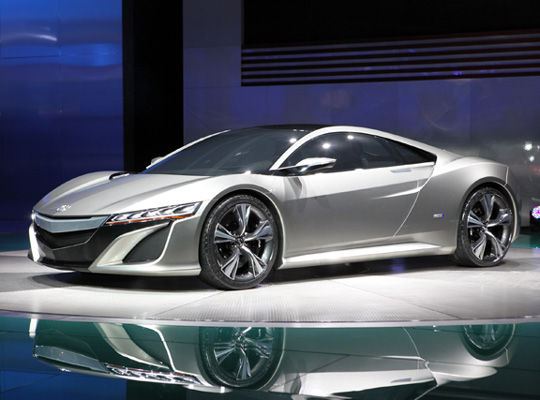
Acura NSX Concept

The NSX was originally scheduled for a revival in 2009 to do battle against Toyota’s LF-A Supercar.  While the car was actually built as the V8 powered HSV GT Concept, it remained forbidden fruit to the public. The global economic crisis ultimately forced Honda to prioritize on volume sales instead of funding halo projects, and production plans were scrapped.

But now the NSX is making a comeback - albeit a painful three years away from production - and it’s greener than ever. Honda ditches the thirsty V8 in exchange for a V6 powered hybrid setup with AWD as standard.  Expect terms like VTEC, Direction Injection and lightweight materials to pad Honda’s green credentials when the car rolls off the assembly line.

Speaking of assembly, the most significant announcement from the NSX revival is that the car will be engineered and built in Ohio.  A strong yen has rendered Japanese exports into a very expensive proposition.  Given that the vast majority of NSXs were sold in North America anyway, it makes sense for Honda to relocate the manufacturing to the NSX’s core market.

The various creases and shapes in the concept’s design are an amalgamation of various existing sports cars (458 Italia? Esprit? Gallardo? It’s all there). But all of that superfluous critical claptrap means very little to the large scheme of things - The People’s Supercar is making a comeback, and it’s here to stay. Long live the NSX.   


Dodge Dart

A quick look through Dodge’s compact car history reveals forlorn nameplates like the Aries, Shadow, Neon, and the recently certified Caliber. While they were responsible for fattening Dodge’s bottom line, none of them were particularly good cars.  Chrysler hopes to change its streak with the revival of the Dart name. Riding atop an Alfa Romeo Giulietta platform, the Dart is the first fruit of Chrysler’s merger with Fiat and Dodge’s answer to anchoring its foothold in the crucial compact sedan market.  It’s an attractive little car - The Charger cues scale well on the Dart, and the blacked out front grille on the R/T model lends a sporty touch a la the Golf GTI.

The interior however is where the Dart really shines. Gone are the fridge binnacle grade plastics and in its place are plush, soft dash materials. Fully digital gauges replace traditional instrument cluster, along with a big 8” touchscreen that operates Chrysler’s UConnect infotainment system. It’s an unprecedented feature on a small car, and made even more incredible as it is slated to go on sale at a smidge under $16,000.

Perhaps the best feature on the Dart? The fully customizable instrument cluster has the speedometer surrounded by virtual flower petals. The petals blossom as a reward for frugal driving, and fall off if the driver has a heavy right foot. 


Falcon F7

The F7 actually debuted at NAIAS last year as a concept, and this is the first chance the vast majority of the public will get acquainted with America’s ‘boutique supercar’ in production guise.  In a world where environmental responsibility has become the norm, the birth of any high powered supercar is enough cause for celebration. The F7 is here to prove that America is no slouch when it comes to supercardom, and on paper it looks every bit as promising as its Hot Wheels inspired looks.  Powered by a modified LS7 engine from Chevrolet that now churns out 620hp and a monstrous 585lb/ft of torque, the F7 will rocket on well north of 190mph. Weight is kept to a svelte 2,785 pounds thanks to liberal swathes of carbon fiber on the bodywork, giving the car a palatable 445 horsepower per ton.  That power to weight ratio is right on par with the best of the best – The Bugatti Veyron gets 446hp / ton, while the 458 Italia manages 378hp / ton.

Don’t think for a moment the F7 is some crackpot millionaire’s supercar fantasy fulfilled.  Falcon Motor Sports has had years of experience as a supplier for the Dodge Viper, and that turned out rather well. To that standard the F7 is on track to become every bit the road beast its spec sheet makes it out to be.

Wednesday, January 18, 2012

Peugeot Suspends LMP1 Programme for 2012

Peugeot has announced it is immediately suspending its LMP1 Program and will no longer compete in the 2012 24 Hours of LeMans.

The unfathomable news came on the final day when teams had to submit their applications to compete in the World Endurance Championship and the 24 Hours of LeMans.

In a public statement released early Wednesday, Peugeot cites a lagging economy as the reason for the decision. The company is refocusing its priorities on sales growth and a revamped product portfolio, which comes at the expense of its involvement in sports car racing.

‘The Brand has decided to close its 2012 endurance programme and will not be taking part in the next Le Mans 24 Hours,’ said the statement. ‘This decision has been taken in the context of a difficult economic environment in Europe. Peugeot has chosen to concentrate resources on its sales performance in 2012.’

Things had not been rosy for Peugeot and its parent company Peugeot-Citroen (PSA). Stagnant sales in a down European Economic climate forced the French automotive conglomerate to undergo drastic consolidation. As part of its €800 million cost-cutting plan in order to stay in business, Peugeot-Citroen was forced to lay off over 6000 employees. The cancellation is the latest round in PSA’s continuing efforts to eliminate as much extraneous expenditure as possible, and casts doubt over the long-term viability of its World Rally Championship programs. 

Peugeot’s absence in LMP1 means Audi Sport will soldier on as the dominant factory effort in the prototype class. The Audi / Peugeot rivalry has been the subject of much controversy over the years and a publicity dream for the ACO, spurring much renewed interest in endurance racing.  The titanic battle between the two giants became the subject of a dramatic documentary in 2008 titled ‘Truth in 24’.

The program’s cancellation also means some of its factory drivers are left unemployed with no seat for the looming 24 Hours of LeMans. Alex Wurz will be joining the new Toyota LMP1 factory team alongside Kazuki Nakajima and Nicolas Lapierre and will campaign at select races for the 2012 season, while Sebastien Bourdais and Simon Pagenaud both found salvation in full time rides in the IndyCar Series in North America. The fate of Peugeot's remaining drivers however remains up in the air. 

Tuesday, January 17, 2012

A Quick Note on Ford's Stance Regarding SOPA / PIPA


Last May, democratic senator Patrick Leahy introduced a bill to the senate titled ‘Preventing Real Online Threads to Economic Creativity and Theft of Intellectual Property Act of 2011’ (PIPA for short). The goal is to broaden the power of government and owners of copyrighted content, giving them the authority to shut down websites that engage in activities constituting piracy and copyright infringement as defined in the bill.  

Many corporations wrote to congress in support of the proposed ‘rogue sites’ legislation, with Ford Motor Company listed among them. The letter of endorsement condemns piracy’s negative impact on the American economy and encourages legislation that will curb fraudulent activity and inhibit copyright infringement.

The United States cannot and should not tolerate this criminal activity. Not only are jobs and consumers at risk, but rogue sites contribute absolutely no value to the U.S. marketplace. The operators of rogue sites break laws, do not pay taxes, and skirt accountability.

A similar bill titled the ‘Stop Online Piracy Act’ (SOPA) has been introduced in October 2011, which builds upon PIPA and details on what is considered illicit activities of piracy and infringement of intellectual property, along with specifics on what can be prosecuted criminally. Due to the similar wording and ultimate intent of the two proposed bills, there was much confusion over who was in support of whom, leading some to believe that Ford Motor Company, who supports PIPA, is now also in favour of SOPA.

Not so, says Ford, who has publicly stated that they do not hold a formal position on SOPA via their official Twitter account.

When asked for clarification on Ford's stance regarding SOPA / PIPA on Google+, the company’s global head of Social Media Scott Monty replied with the following statement:

Ford has expressed the need to protect our intellectual property - there are hordes of counterfeiters out there who make Ford parts and goods that are not officially licensed. Plus, we have a pretty significant commitment to the technology field, with lots of efforts that result in proprietary information that, if it were compromised, would be counter-productive. This hurts our licensees and our customers and is not tolerable. While we want to ensure our IP is protected, we do not encourage legislation that fundamentally changes the Internet. 
We have expressed interest in working with Congress to find a balance that keeps the Internet open yet protects intellectual property.

Meanwhile, many websites including Wikipedia and Reddit will be shutting down service for 24 hours on January 18th to protest the proposed legislation, the day unofficially dubbed 'National Blackout Day'.